IoT Soil Sensors in African Agriculture: A Practical Guide
Learn how to evaluate soil sensors, NPK claims, connectivity, installation and maintenance before investing in connected monitoring for an African farm.
Published by Faminga. Prepared with AI-assisted research and drafting; sources checked on 5 September 2026. Product descriptions are attributed to their providers. Examples and evaluation checklists are editorial guidance, not results of a comparative field trial.
IoT soil sensors in African agriculture connect a physical measurement in the field to a record that somebody can use. Their value depends on the whole chain: an appropriate instrument, a sensible installation point, reliable power and communication, and a clear response when the reading changes.
For a farmer, the useful question is simple: what will this sensor help me decide? For a cooperative, there is a second question: who will keep the system working after installation? This guide provides a way to evaluate both before investing in a network of devices.
Start with the measurement, not the dashboard
A dashboard may show moisture, temperature, pH, electrical conductivity and NPK values together. That does not mean those measurements use the same method or have the same reliability. Ask the supplier for a specification for each channel: what it measures, in which units, under what conditions, and with what stated uncertainty.
For moisture, the University of Minnesota's sensor guidance distinguishes instruments estimating volumetric water content from those measuring soil water tension. It also explains why soil conditions and calibration matter. Those are different quantities; their readings should not share a threshold simply because both concern water.
Ask to see an exported record. A useful record identifies the device, field, depth, measurement time, unit and quality status. If the supplier can only show a coloured dial, you cannot easily examine what changed or compare it with another measurement.
Five questions for an NPK sensor supplier
“NPK sensor” is a product label, not a complete measurement specification. Before using its readings to guide fertiliser decisions, request written answers to these questions:
- Which forms of nitrogen, phosphorus and potassium does the device report?
- Does it measure each separately, or estimate them from another signal?
- What sample preparation or soil contact is required?
- Which reference laboratory method was used to evaluate it?
- Can the supplier show comparison results for soil conditions resembling your fields?
Keep the comparison method consistent. A handheld device and a laboratory may report different properties, extraction methods or units. Ask a qualified soil specialist to interpret the relationship. A close-looking pair of numbers is not enough to establish that one method can replace the other.
Request a demonstration that includes repeat readings and a discussion of disagreement. This is a better purchasing test than watching the device display a plausible number once.
What happens between the probe and the phone?
A typical connected system has a probe, a recorder or node, a communication link and a place to store and display observations. Some systems communicate locally; others send data through a gateway and an internet connection. Ask the installer to draw the actual route used on your farm.
For a proposed LoRa installation, establish whether it uses LoRaWAN or a supplier-specific arrangement, where the gateway will sit, and how that gateway reaches the service. A long-range radio connection does not automatically provide internet access. Test communication at the installation location with the equipment and power arrangement that will remain there.
Ask what happens during each failure: a flat battery, a disconnected probe, a gateway outage or loss of mobile coverage. The system should distinguish a missing reading from an unchanged reading. A dashboard displaying yesterday's moisture without a visible timestamp can mislead the person deciding whether to irrigate.
Choose installation points around management decisions
Start by identifying areas managed differently. A greenhouse bed, a slope and a lower patch may need separate attention. The objective is to represent the decision area, not to distribute devices in a visually pleasing pattern on a map.
Record why each location was chosen and photograph the installation. Label the depth and relationship to the crop and irrigation equipment. This helps a future technician understand what the reading represents and reduces the chance that a moved sensor is interpreted as a change in the field.
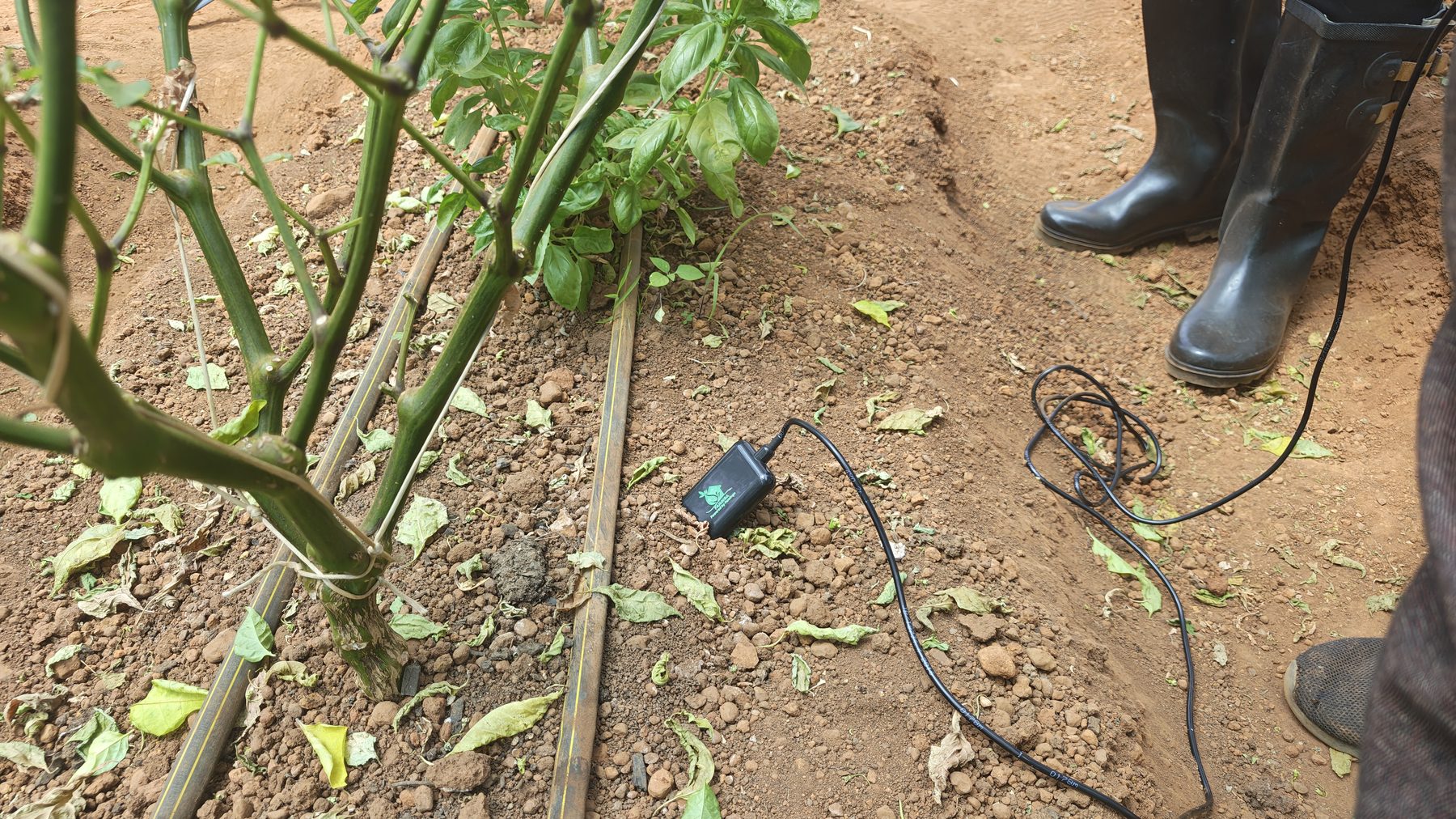
Our existing Bugesera field article illustrates Faminga's soil-monitoring work in a greenhouse. A field image is useful context; assessing a service also requires measurement records, maintenance history and evidence across the conditions in which it will operate.
Commission a small network before expanding
Agree on an acceptance test before installation. It should establish that the correct device is linked to the correct field, timestamps are consistent, units are labelled and an exported record matches what appears on the screen.
Test the alert route with a controlled demonstration that does not change irrigation or apply inputs. Confirm who receives the alert, how they acknowledge it and what happens when the primary contact is unavailable. Farmers need an understandable message with a next step, not only a technical error code.
Keep a commissioning sheet with the device identifier, installation date, location description, responsible person and next check. A cooperative can use the same sheet for every installation and quickly identify sites missing essential information.
Calculate the full seasonal cost
A low probe price can hide a costly service. Ask for a breakdown covering nodes, gateway, power, data, installation, calibration or checks, software access, training, replacement parts and travel for maintenance. Establish which costs repeat and which are paid only once.
Then compare the total with one named benefit you intend to measure. If the objective is fewer unnecessary irrigation visits, record visits and staff time before and after the trial. If the objective is better water management, measure water delivered and crop results. Do not convert an attractive manufacturer claim into a farm-specific saving.
It may be more economical to begin with a well-supported shared service than to buy many devices without a maintenance budget. The right choice depends on who can respond to the information and keep collecting it consistently.
Faminga and the integrated field record
Faminga's public platform description connects soil monitoring with digital farm management. The useful implementation question is whether the sensor record can be interpreted alongside the field's crop, recent activities and other observations. Ask for a demonstration of that exact workflow and the equipment it requires.
For the next step, read the smart irrigation guide to connect measurements to water decisions, or the satellite monitoring guide to understand how point measurements and wider imagery complement one another. The Rwanda precision agriculture guide brings those layers together.