Ten Agritech Trends Reshaping Rwandan Agriculture in 2026
Faminga's Project Manager on the ten shifts that actually matter in Rwandan agriculture in 2026 - the national soil map, the EUDR coffee deadline, the land registry, agri-lending, and the connectivity constraint none of them design around.
By Eugene Bucyansenga — Project Manager, Faminga
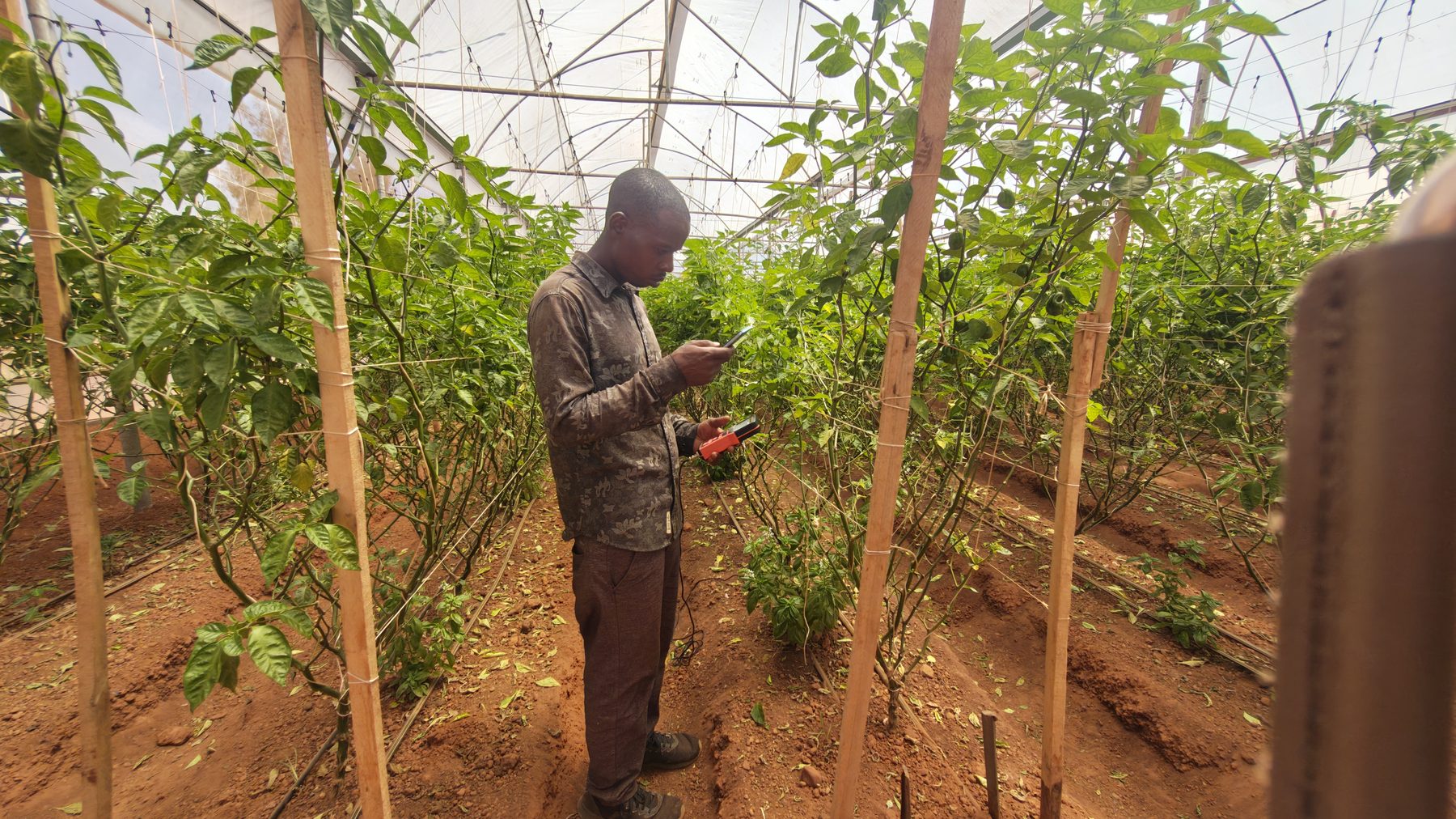
Rwanda is a small country with an unusually complete set of records. Every land parcel has a number. Most farmers are in a cooperative. A single national system handles the fertiliser subsidy. That combination is rare on this continent, and it changes which agricultural technologies are worth building here — and which ones are a waste of everyone's season.
I run delivery at Faminga, which means I spend less time reading about trends than watching which ones survive contact with a hillside in Bugesera. What follows is the ten shifts I think actually matter in Rwanda going into 2027, with the numbers behind them and, where the numbers are shaky, a note saying so.
A warning about the genre first. Most "agritech trends" articles are a list of global technologies with a country's name appended, propped up by statistics like "precision farming increases yields by up to 30%." Those figures are usually real studies conducted somewhere that looks nothing like Nyagatare. I have tried to use Rwandan numbers, name their source, and say when a claim is a projection rather than a measurement. Faminga sells some of the technology described below, and I have flagged that where it comes up.
Soil intelligence became national infrastructure, not a product
In December 2024, RAB launched RwaSIS, the Rwanda Soil Information System, after four years of sampling. It covers six priority crops — cassava, potato, rice, wheat, maize and beans — and returns site-specific fertiliser recommendations rather than the blanket rates that have governed Rwandan fertiliser use for a generation.
The important detail is not the science. It is the delivery route: recommendations flow into the Smart Nkunganire System, the subsidy platform built by BK TecHouse with RAB, which has registered over 2.4 million farmers and is reachable on *774*1# — a USSD code that works on a feature phone with no data.
For anyone building here, that is the lesson of the decade. A soil model with no distribution is a paper. Rwanda has already solved distribution.
Agricultural AI is being asked to speak Kinyarwanda
At the Africa Food Systems Forum in Kigali on 1 September 2026, Minister of State for Agriculture Dr Solange Uwituze described Tunga, an AI voice assistant tested through MINAGRI's call centre that answers farmer questions in Kinyarwanda, and cited early tests pointing to yield gains of around 20% from tailored fertiliser advice.
Treat that 20% as an early indication, not a result — I have not seen the trial design published, and "early tests" is doing a lot of work in that sentence. What is not in doubt is the direction. Rwanda's target is to lift extension coverage from 35% in 2023 to 69% by 2029, reaching more than 2.5 million farmers. There are not enough agronomists in the country to do that with people alone.
The enabling work is linguistic, and it is largely Rwandan: Digital Umuganda and the Mbaza NLP community have been building Kinyarwanda speech recognition and text-to-speech as open resources for years. An advisory tool that only works in English is not an advisory tool in Rwanda. It is a demo.
Traceability stopped being a nice-to-have and became a customs requirement
This is the single largest forcing function on Rwandan agritech right now, and it has a date on it.
The EU Deforestation Regulation requires that coffee entering the EU be proven deforestation-free since 31 December 2020, evidenced by plot-level geolocation. It applies to large and medium operators from 30 December 2026, with small operators given until 30 June 2027. Rwanda is classified low-risk, which lightens the paperwork — it does not remove the geolocation requirement.
NAEB has been running a National Coffee Census to map plots, and a 28-member national working group covering the whole value chain has been convened with UNDP and GIZ support. Coffee is a smallholder crop here, which is exactly what makes this hard: compliance means knowing where several hundred thousand individual plots are.
Anyone who can attach a verified polygon to a farmer's coffee has a business in Rwanda in 2027. That is not a prediction; it is a regulation.
Irrigation is going solar, small, and subsidised
Rwanda plans to expand irrigated land from 71,585 hectares to 132,171 hectares by 2029. The instrument doing most of that work at farm level is Small-Scale Irrigation Technology — pre-assembled drip, sprinkler or rain-gun kits for holdings between half a hectare and ten.
The subsidy structure is the part worth knowing: government covers 50% of equipment cost for farms of 0.5–10 ha, rising to 75% for solar-powered pumps on farms of 5–10 ha. Solar is being deliberately priced below diesel by policy, not by market forces.
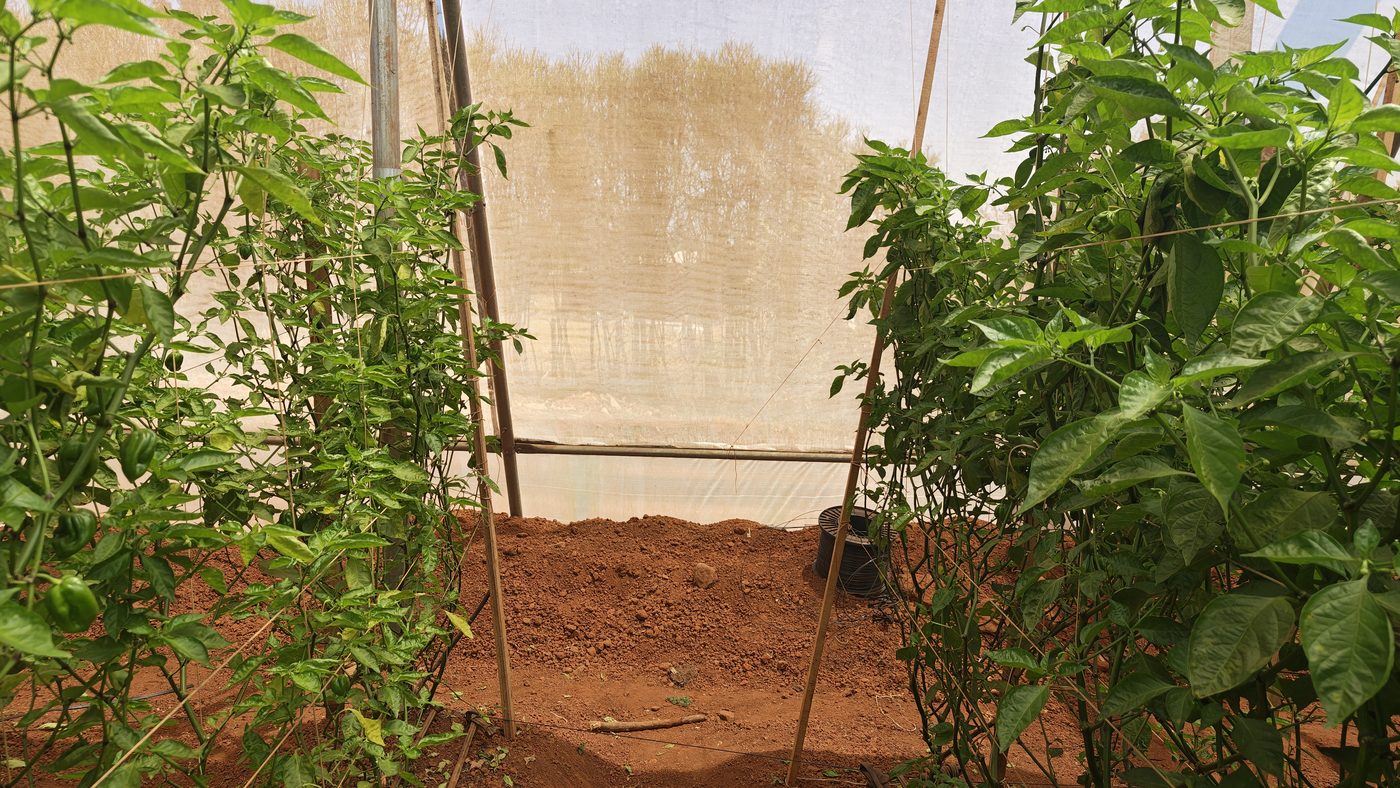
Which is where the gap sits. A subsidised pump with no scheduling logic waters on habit. Pairing the kit with soil moisture data is the cheap half of the problem and the half most often skipped — and yes, that is a thing we build, so weigh the recommendation accordingly.
Insurance is becoming the on-ramp to credit
The National Agriculture Insurance Scheme subsidises 40% of the premium and has paid out over RWF 6.4 billion in compensation to date — RWF 3.49 billion to crop farmers, RWF 2.95 billion to livestock keepers. Roughly 161,000 crop farmers and 50,000 livestock keepers enrol annually.
Uptake is still under 10%, against a target of 30% within five years. But the interesting function of NAIS is not risk transfer to the farmer. It is that an insured farmer is a different proposition to a lender — which leads directly to the next trend.
Agricultural lending is finally moving, from a very low base
Agriculture, forestry and fishing accounted for just 2.7% of total bank loans as of June 2025 — in a sector that employs something like 43% of the workforce. That is the real constraint on Rwandan agriculture, and no amount of sensor deployment fixes it.
There is movement. BNR data shows new agricultural lending up 177% in the first half of 2026, reaching RWF 57 billion. PSTA 5 targets 10% of total bank loans by 2029.
What unlocks it is not enthusiasm but evidence: registered land, an insurance policy, a repayment history, a verified yield record. Every one of those is a data product. The agritech opportunity in Rwandan finance is less about lending apps than about producing the four documents a credit committee actually wants.
The land registry is Rwanda's unfair advantage
Rwanda registered 11.4 million land parcels through its Land Tenure Regularisation programme, completed in 2013. Every parcel carries a Unique Parcel Identifier — a structured code encoding province, district, sector, cell and parcel number.
It is difficult to overstate how much this changes what is buildable. In most of the region, "which field is this?" is an unanswerable question, and every platform reinvents its own farm identity, badly. In Rwanda there is a national primary key. RwaSIS already uses it: a farmer enters their UPI and receives soil composition, crop suitability, erosion risk and fertiliser rates for that specific parcel.
UPI is also the natural spine for EUDR geolocation, for collateral assessment, and for any cooperative trying to reconcile members to plots. If you are designing an agricultural data model for Rwanda and it does not have a UPI field, you have designed it for somewhere else.
Post-harvest is shifting from the farm to the hub
Post-harvest losses have come down — 13.8% for maize, 11.3% for beans, 12.4% for rice. The government is targeting below 5% by 2029, and is building grain handling hubs with combined capacity above 200,000 tonnes.
One statistic explains the strategy better than any of those. Only about 1.9% of maize and 0.5% of beans are retained by farmers after harvest. Rwandan smallholders are not storing and losing their crop — they are selling almost all of it immediately, often at the season's worst price, because they have neither storage nor the working capital to wait.
That reframes the technology. On-farm storage sensors solve a problem most Rwandan farmers do not have. Price forecasting, aggregation logistics and warehouse receipts address the one they do.
Satellite, sensor and phone are converging on the same plot
Individually these are old news. What is new in Rwanda is that they now share an identifier and a delivery channel, so a satellite index, an in-ground probe and a farmer's handset can refer to the same parcel without a reconciliation project.
Rwanda's terrain makes this harder than the marketing suggests: steep slopes, small fragmented plots, and persistent cloud over much of the country during the growing seasons. Optical satellite imagery is unreliable here in ways it is not in the Sahel, which is why ground sensors are not a luxury add-on but the thing that keeps the model honest when the sky is closed for three weeks.
This is our own working area, so read it as a practitioner's view rather than a neutral survey. We wrote up the mechanics separately in our precision agriculture guide.
There is now a real youth agritech bench
The AYuTe Africa Challenge Rwanda 2026, run by Heifer International Rwanda, drew more than 1,200 applicants aged 18–35, shortlisted 12 for a bootcamp, and awarded RWF 65 million at the finale at Camp Kigali on 30 April 2026 — up from RWF 50 million the previous year.
Twelve funded teams is not an industry. But it is a measurable increase in the number of Rwandans who have built something agricultural and had it stress-tested by people who know the sector, and that is the input that has been missing. We have written a fuller survey of Rwandan agritech companies for anyone wanting the landscape.
The constraint none of these trends design around
Every item above assumes a farmer can be reached. Here is what reach actually looks like in Rwanda, per the ITU and NISR's EICV7 survey:
- 38% of the population was online as of mid-2025, up from 34% the year before
- 57% internet use in urban areas against 19% in rural areas — where the farms are
- Only 34% of households own a smartphone, at a typical cost of 60
- For the poorest Rwandans, a basic smartphone plus 1GB of data can consume up to 60% of monthly income
Against that: mobile money access sits around 91%, and there were roughly 13.3 million active SIMs at the end of Q2 2025. Rwandans are connected. They are not, mostly, connected in the way a React dashboard assumes.
This is why *774*1# matters more than any app I could name, and why the government's push toward universal smartphone access by 2027 is an agricultural policy as much as a digital one. Until that lands, any Rwandan agritech product with a hard dependency on a smartphone and a data bundle is addressing the top third of the market and calling it the market.
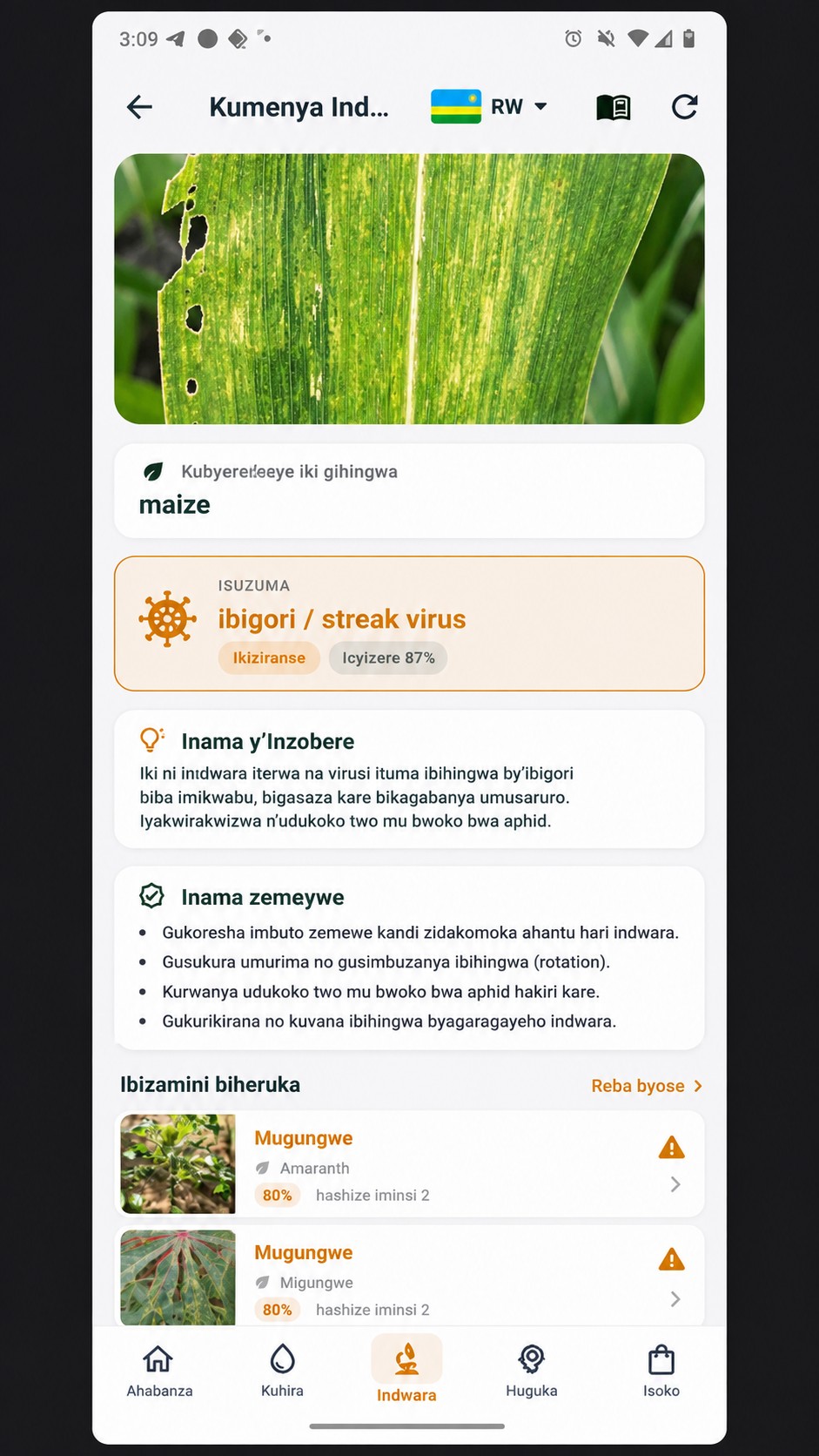
A result in Kinyarwanda. The language is not a localisation task at the end of the build; it decides whether the product is usable at all. What I would watch in 2027
Three things will tell you whether this decade of investment worked.
Whether the EUDR deadline is met without shutting smallholders out. The failure mode is not Rwanda missing the date — it is exporters meeting it by narrowing to the few thousand farmers who are easiest to map, and quietly dropping the rest.
Whether agricultural lending holds above 5%. A 177% jump from a small base can reverse in one bad season. Two consecutive years of growth would mean the underwriting genuinely changed.
Whether extension coverage moves. 35% to 69% by 2029 is the target that makes every other number on this list reachable. If AI advisory tools are working, that figure moves. If it does not move, the tools are being counted rather than used.
Rwanda's advantage was never scale — it is coordination. The registry, the subsidy rail, the cooperative structure and the soil map are the same asset viewed from four angles: the country knows who its farmers are and where their land is. Very few places do. The work now is making that knowledge useful to the person standing in the field, in their language, on the phone they already own.
Figures cited were checked on 6 September 2026 against MINAGRI, RAB, NAEB, BNR, NISR, ITU and Heifer International sources, each linked above. Where a figure is a target or an early indication rather than a measured outcome, it is described as such. Faminga builds soil sensing, AI advisory and farm data tools in Rwanda and therefore has a commercial interest in several of the trends described here.