Best AI Farming Apps in Africa in 2026: A Practical Comparison
Compare seven AI farming apps and advisory tools for African farmers, with practical checks for crop coverage, offline access, language and support.
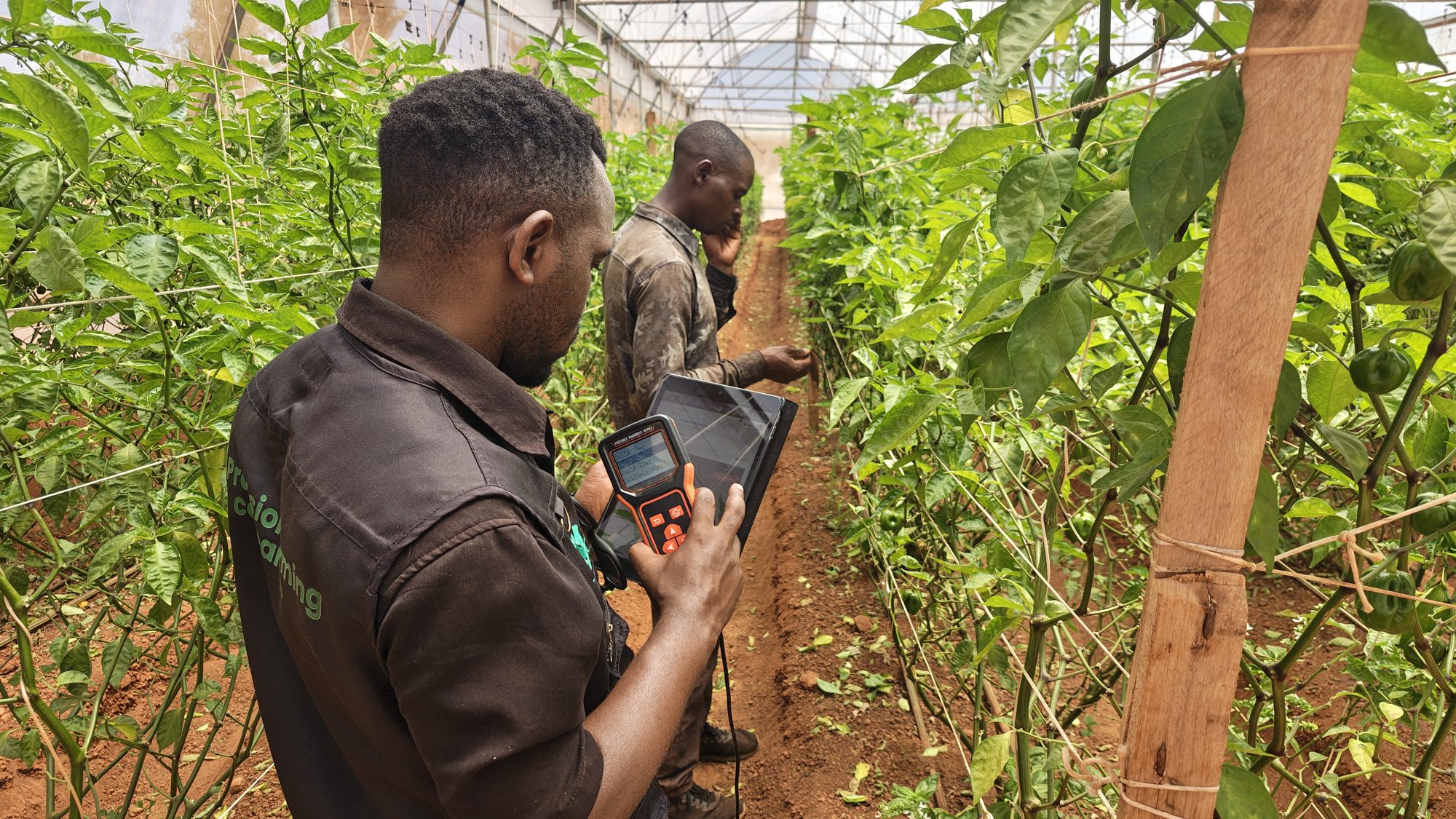
Published by Faminga. Prepared with AI-assisted research and drafting; sources checked on 5 September 2026. Product descriptions are attributed to their providers. Examples and evaluation checklists are editorial guidance, not results of a comparative field trial.
Choosing an AI farming app in Africa starts with a practical question: which decision do you need help making this week? Identifying a damaged leaf, planning fertiliser, keeping field records and estimating an orchard harvest are different jobs. The most useful app is the one that supports your crop, language, phone and working conditions at the moment you need it.
This 2026 comparison covers seven tools with distinct uses. It includes downloadable apps, a WhatsApp service and an organisation-supported helpline, because the access channel matters as much as the AI. Faminga publishes this guide and is one of the products discussed. The selection is an editorial shortlist based on linked provider information checked on 5 September 2026, not a hands-on accuracy ranking or a claim that every service is available everywhere in Africa.
Choose by the farming problem first
- Keeping farm information together: investigate Faminga.
- Photo-based crop problem identification: compare Plantix and PlantVillage Nuru against your supported crops.
- Conversational farming advice: investigate FarmerChat.
- Field-specific nutrient planning through WhatsApp: investigate iSDA Virtual Agronomist.
- Local-language advisory delivered through a farmer network: investigate Darli.
- Commercial fruit measurement and yield forecasting: investigate Aerobotics.
These categories overlap. Use them to make a shortlist, then run the same small trial with each candidate. Avoid buying a broad subscription before confirming that the one feature you need actually works for your farm.
Faminga: farm management with an African smallholder focus
Faminga's Google Play listing describes a smart farming app combining crop diagnosis, soil monitoring, weather and satellite insights. Its stated audience is African smallholder farmers. That makes it a relevant option when a farmer wants several field signals associated with the same farm record.
The selection question is whether those connections make your daily work easier. Ask for a demonstration that begins with your crop and field, records a problem, and ends with an action you can find again. Check which features need separate hardware, a subscription or connectivity. Treat the listing as a product description rather than an independent measurement of diagnostic accuracy or farm impact.
For a cooperative, the useful trial is a complete workflow: a member records an observation, the responsible adviser sees it, and the farmer can understand the response. Agree on who will provide support before enrolling a large group.
Plantix: photograph a crop problem and explore guidance
Plantix offers photo-based crop diagnosis, treatment suggestions, a knowledge library and a farming community. It is worth comparing when the immediate task is to understand visible crop symptoms. Confirm your crop and language in the current app before relying on it during a season.
A photograph is only part of the evidence. For any diagnostic app, keep the planting date, recent rainfall and previous treatments beside the result. Ask whether the suggested action fits the local situation. Our crop disease app comparison explains how to conduct a more useful field trial.
PlantVillage Nuru: an important offline diagnosis example
Penn State documented Nuru's offline cassava diagnosis in 2019. The source establishes a real example of diagnosis running on a smartphone without an internet connection. It is historical evidence, not a current catalogue of every supported crop or phone.
Nuru belongs on the shortlist when connectivity is the main constraint. Before deployment, confirm the current official download, supported crop models and initial setup requirements. Test a new photograph after restarting the phone with mobile data and Wi-Fi disabled. An old result opening successfully does not prove that a new diagnosis works offline.
FarmerChat: voice, text and photo questions
Digital Green's FarmerChat describes advice through voice, text and photographs, with responses adapted to local farming conditions. This format is relevant for farmers who find conversation easier than navigating a large dashboard.
Try a question in the language and phrasing you normally use. Then ask a follow-up that changes one important fact, such as the crop's growth stage. Evaluate whether the conversation preserves that context. The quality of a fluent answer matters less than whether it helps identify the next safe, feasible step.
iSDA Virtual Agronomist: plot-specific advice through WhatsApp
Virtual Agronomist uses WhatsApp to provide tailored nutrient plans and agronomic advice. iSDA describes a partner rollout process that includes adapting the service to local crops, prices and input availability.
This is relevant for farmer organisations seeking advisory support through a familiar messaging channel. Ask which country, crop and partner arrangement applies to your intended users. A public demonstration is useful for understanding the interaction; it does not establish the terms or coverage of a full deployment.
Darli: advisory access beyond a standalone app
Mergdata's Darli describes AI-supported communication and a farmer helpline reached through a toll-free short code. Its organisation-oriented approach is relevant when a cooperative, buyer or development programme wants to support a farmer network.
Ask the provider to demonstrate the actual number, language and service arrangement in your country. Distinguish a voice call from offline processing: a call may avoid mobile internet but still needs a functioning telephone network. Check who pays for access and who handles questions that the automated service cannot resolve.
Aerobotics: a specialised option for fruit businesses
Aerobotics focuses on fruit growers, packers and marketers, including yield forecasts informed by smartphone measurements of fruit size, colour and quality. It is a different proposition from a general smallholder advisory app.
Consider this category when harvest planning and fruit specifications drive the business decision. Ask whether the sampling process fits the orchard and whether staff can collect consistent images. A specialised tool can be valuable without being the appropriate first app for a mixed-crop smallholder.
A field trial that produces a useful buying decision
Choose three real tasks before comparing apps. For example, save a field observation, ask a crop question in your preferred language, and retrieve the record later. Use the same phone and task descriptions for every candidate. Record where help was needed, how long the task took, and whether the final output was understandable.
Then repeat the essential task with weak or absent connectivity. Separate installation, login, model download, new analysis and later synchronisation. Our offline farming guide provides a more detailed checklist.
For costs, request the full seasonal total: subscription, data, equipment, setup, training and support. For privacy, ask who can see field boundaries and photographs, how records can be exported, and how a shared phone is handled. These questions often reveal more about suitability than another feature comparison.
Where to start
Start with the tool that solves your most frequent decision and can be supported locally. Add other capabilities when you can name the additional task they improve. If you want to explore Faminga, review the current app listing and Faminga's approach, then test your own workflow. For the wider context, read our existing overview of AI solutions in African agriculture.