5 Billion AI in Agriculture Forecast, Read From a Field in Rwanda
Four research firms forecast 0-25 billion for AI in agriculture by 2035; a LinkedIn post says
5.5 billion. What the spread means for a farmer in Rwanda.
By JMV Mutabaruka — User Experience Officer, Faminga
Someone shared a post on LinkedIn this week saying the AI-in-agriculture market will hit
5.5 billion by 2035. It came with a brochure link and a list of trends: computer-vision sprayers, autonomous tractors, generative AI for farmers, edge chips on machinery. We got curious about the number, because we've seen a few of these and they never seem to agree with each other. So we looked up what the research firms actually publish, and then tried to work out what any of it means for the farmers we work with in Bugesera.
One thing before we start: Faminga sells AI advisory and soil sensing tools in Rwanda, so we're not neutral about this market. Read with that in mind.
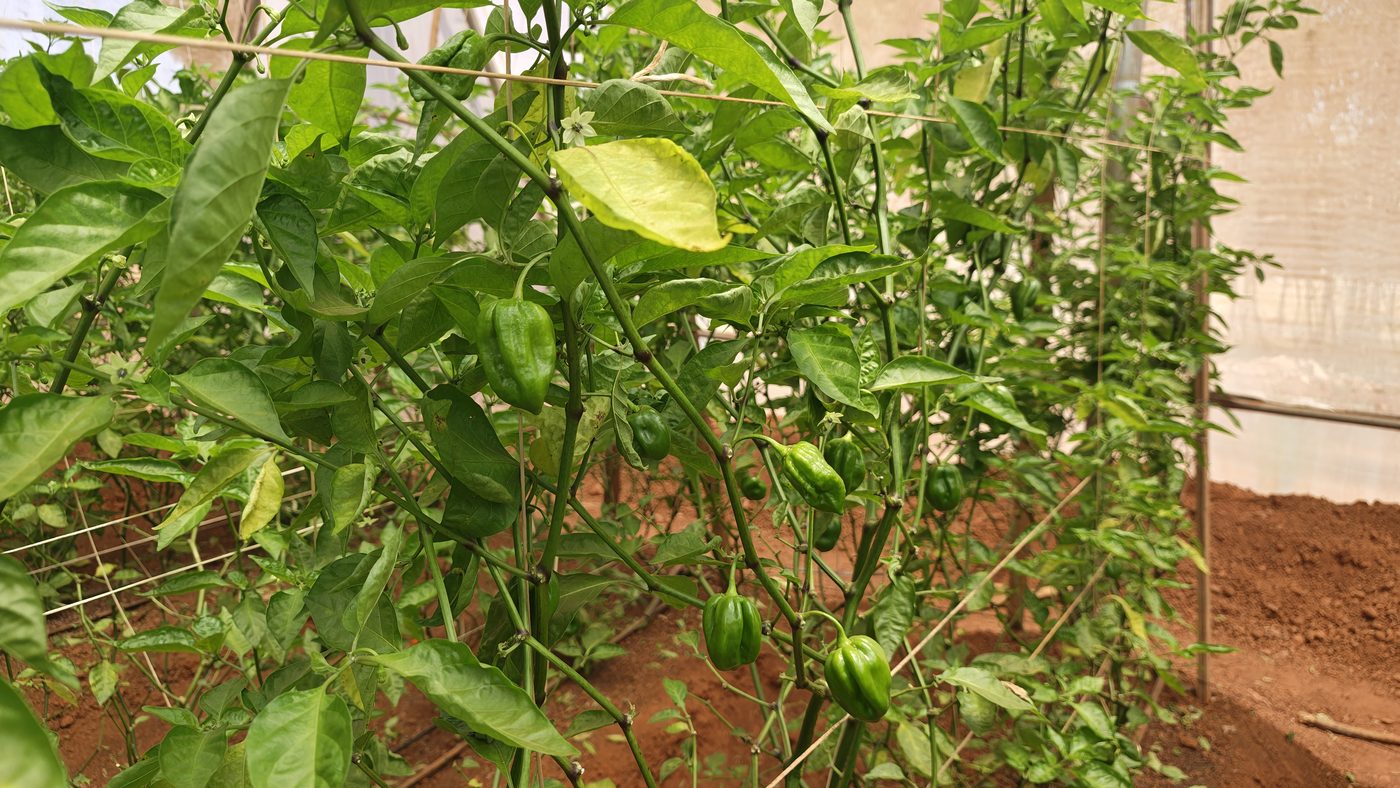
One of the greenhouses we work in at Bugesera. Not one of the forecasts below mentions Africa.
The number depends on who you ask
Here's what the firms that publish their working actually say. The LinkedIn post compressed all of this into one headline.
.7 billion in 2023 and expects $4.7 billion by 2028. That's 23.1% a year. Last updated October 2024.
Roots Analysis: .14 billion in 2024, 0.96 billion by 2035, 23.06% a year. Updated August 2026.
Precedence Research: .57 billion in 2025, 0.12 billion by 2035, 22.85%. Updated 26 August 2026.
SNS Insider, in a July 2026 press release: .78 billion in 2025, 4.55 billion by 2035, 24.34%.
The LinkedIn post's
5.5 billion links to a sample-download page at a publisher called Market Research and News. We couldn't open it — the page blocked us — so we don't know their base year or how they got there. It's about 45% higher than anyone else.
What struck us is that everyone agrees on the growth rate, within a point and a half. Nobody agrees on the starting point.
.7 billion in 2023 and .78 billion in 2025 can't both describe the same market unless it grew 64% in two years, which it didn't. They're measuring different things and calling them by the same name. Compound the same 23% from different bases for ten years and you get $5 billion or 5 billion depending on where you started.
Precedence's own page gives you a sense of how carefully these get written. The opening paragraph says the market is "
6.78 billion in 2026". Scroll down to the tables and 2026 is
.17 billion. Same report, same year, off by ten times. We don't think anyone's lying. We think the headline is the product and the tables are an afterthought.
So, honestly: the market is growing somewhere around 20 to 25% a year, from a base nobody can pin down within a factor of two. That's a fast-growing sector. It's also a small one. Take the most generous 2025 figure and the whole global AI-in-agriculture industry still makes less in a year than one mid-sized fertiliser company.
Food demand was the argument before AI existed
The post opens with rising food demand, and fair enough. Back in 2009 the FAO said the world would need 70 percent more agricultural production by 2050 to feed another 2.3 billion people. They revised that in 2012 to 60 percent above 2005/07 levels, once they had better data.
Two small things. The number went down ten points when someone checked it, which is worth remembering when a forecast is presented as settled. And the demand was there long before anyone put a neural network on a tractor. AI is one possible answer to a question that was already on the table. That's the real case for the sector, and it doesn't need a 5 billion headline.
The labour shortage isn't ours
This is where the post stops describing Rwanda.
Autonomous tractors, harvesting robots, driverless fleets — three of the listed trends exist because farms in the US and Europe can't find people. Deere's tillage autonomy kit went out to around twenty early customers in 2025, on 8R and 9R tractors, with a full launch planned for 2026. It's a real product for a real problem. The problem is a farm that can't hire a driver for a tractor that costs more than a house.
The "ageing farmer" story that gets attached to all this is often applied to Africa too, and it's just not true here. Yeboah and Jayne went through survey data from six countries — Nigeria, Tanzania, Rwanda, Uganda, Ghana and Zambia — and found the farm workforce averages 32 to 39 years old. The widely repeated "African farmers average 60" line came from an FAO comparison with the United States in 2014 that, as the authors put it, had no data behind it for this region. Rwanda is in their sample. Our farmers are young. There are a lot of them. Many don't have enough work.
So labour isn't the scarce thing in Rwanda. Land is. Working capital is. Reliable information is. A driverless tractor solves the wrong problem, at a price that would buy the whole farm several times over. When a report says the market is being driven by "critical agricultural labour deficits", it's telling you the customers are in Iowa and Bavaria. That's useful to know. It also tells you where the money is going, and it isn't here.
Spot-spraying works. But "up to 80%" is the best day, not the average
The post says computer-vision sprayers cut chemical use "up to 80%". Deere's See & Spray is the best-documented version of this, and Deere's own numbers are more modest. Over five million acres in 2025, customers cut non-residual herbicide by an average of nearly 50% — about 31 million gallons of mix. The year before, Deere had headlined 59%. 2025 was wet and weedy and the average came down. "Up to 80%" is a good field in a good year. Half is what five million acres actually got.
Half is still a lot, and the idea underneath it travels even where the machine doesn't. What See & Spray really does is move a decision — where to put the input — from a blanket rate to a per-plant call. In Rwanda that same shift is happening with fertiliser instead of herbicide, and through a database instead of a camera. RAB's RwaSIS gives parcel-specific fertiliser rates for six priority crops instead of one national rate, and pushes them out through the Smart Nkunganire subsidy platform over USSD. The farmer still applies it with a knapsack sprayer. That's fine. The waste was in the recommendation, not the sprayer.
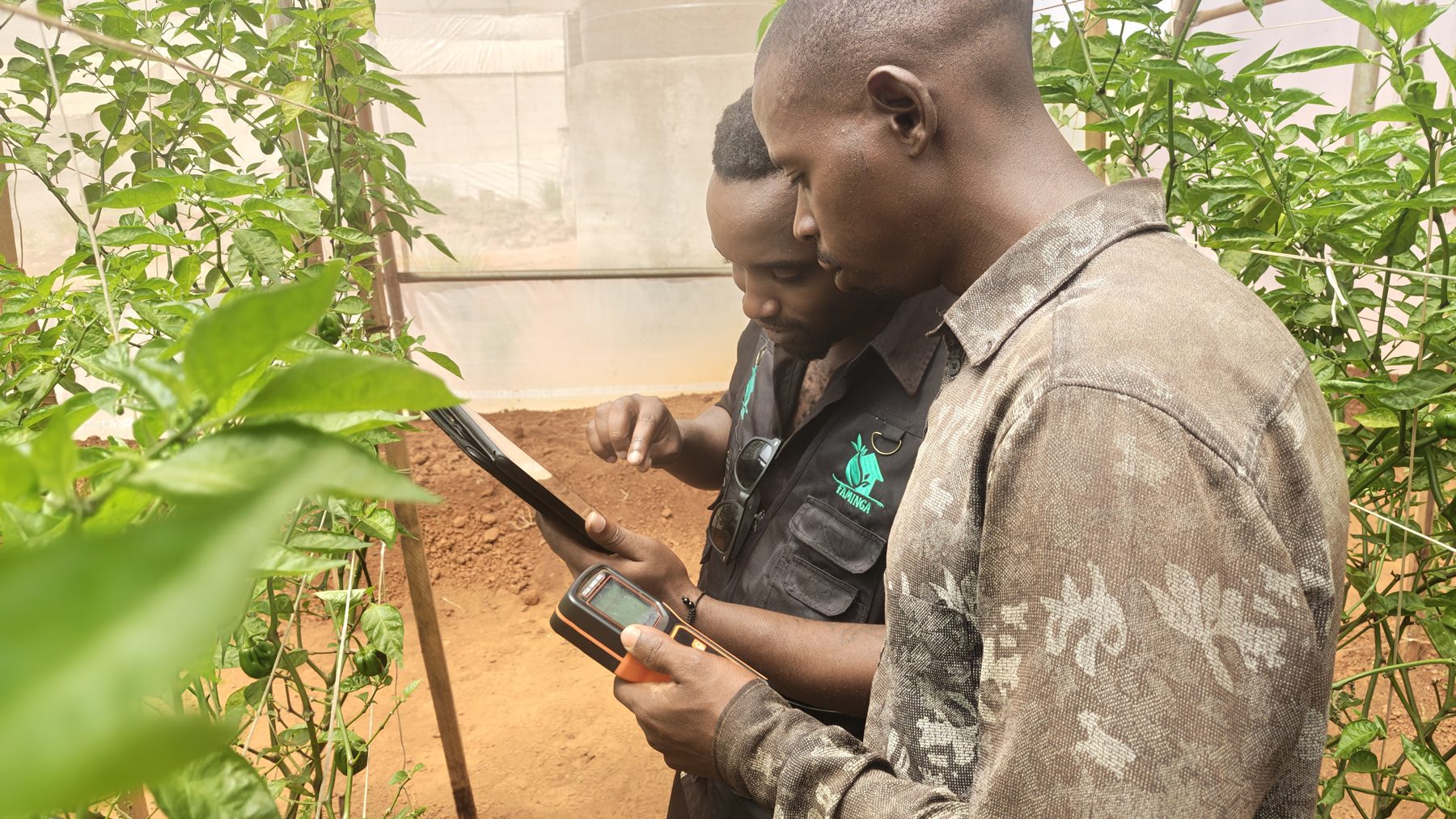
Going over a soil reading in Bugesera. The decision changes; the sprayer stays the same.
AI that speaks Kinyarwanda is the trend that actually fits
Of everything on the post's list, the one with the shortest path to a Rwandan field is the least mechanical: letting farmers and agronomists ask about their field, their soil and the weather in plain language.
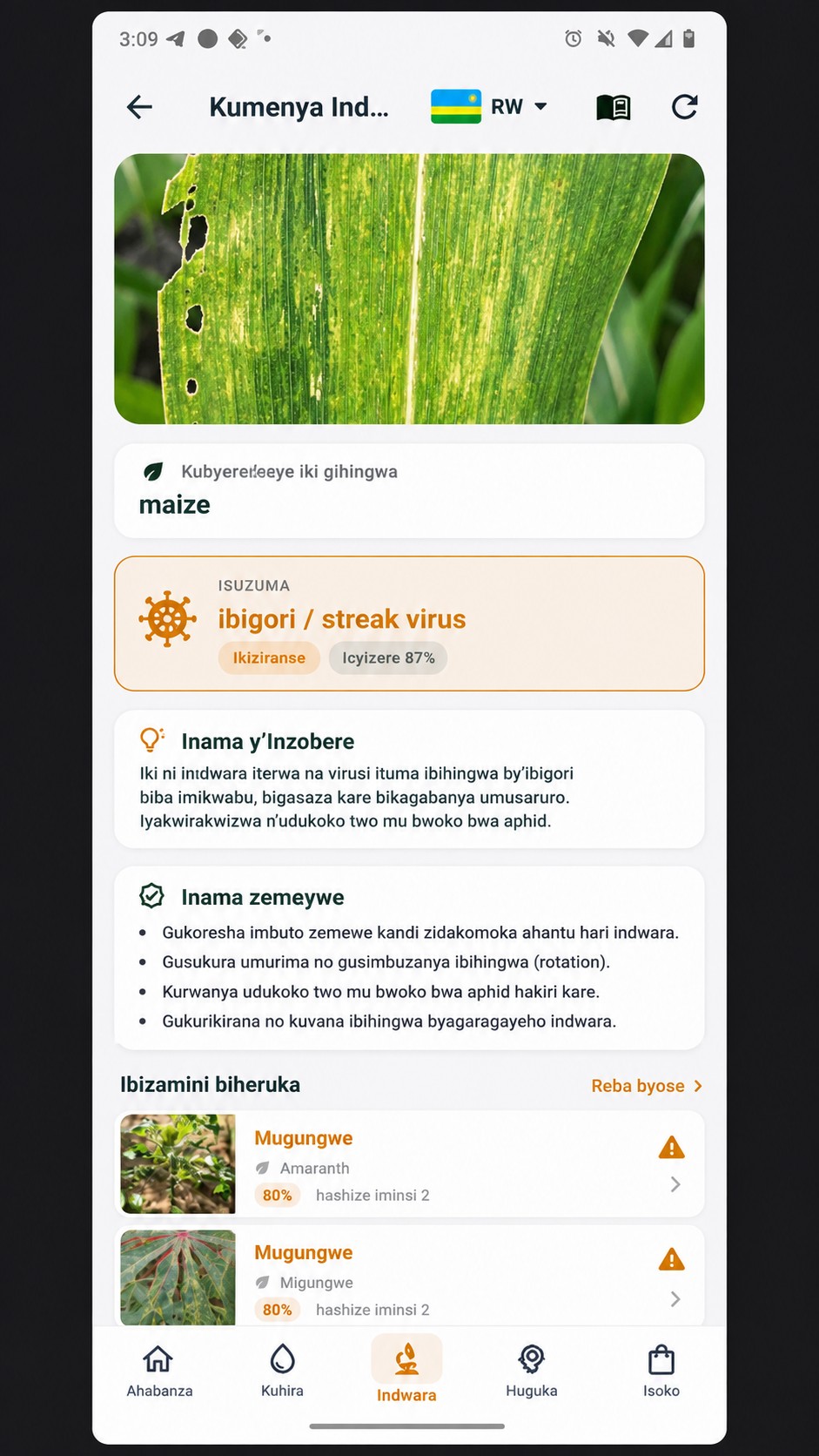
One thing the reports never say: the language isn't a translation step you bolt on at the end. A model that only answers in English isn't an advisory tool in Rwanda. It's a demo. We've written about this before, for disease detection and for farm data generally.
A diagnosis in Kinyarwanda. If it's not in the farmer's language, it doesn't count.
"Edge AI" when the edge is a feature phone
The post's innovation list starts with edge-AI chips on farm machinery, so the model can run in a field with no signal. Sensible engineering. It assumes the farmer turns up with a $500,000 vehicle to put the chip in.
Here's what the edge looks like in Rwanda, per the ITU and NISR. About 38% of people were online as of mid-2025 — 57% in towns, 19% in rural areas, which is where the farms are. 34% of households own a smartphone, and a basic one costs around
60. On the other side of the ledger, mobile money access is around 91% and there were roughly 13.3 million active SIMs at the end of Q2 2025. So people are connected. Just not in the way a cloud dashboard assumes.
"Run it at the edge" here means one of two things. Either the model is small enough to run on a mid-range Android phone with the data switched off — which is a real and growing category, and it's how our own disease detection works offline — or the model lives on a server and the last mile is USSD and voice, which is how the fertiliser subsidy already reaches 2.4 million registered farmers on *774*1#. Neither of those is what the brochure means by edge AI. Both are what it has to mean if this market is going to include anyone here.
Where the money is going
Look at the regional tables and the picture is consistent. Precedence gives North America "more than 39%" of 2025 revenue. Roots says 40%, with Asia-Pacific growing fastest. SNS Insider breaks out the United States ($0.77 billion in 2025, $6.63 billion by 2035) and Europe (
.28 billion to $6.08 billion), and doesn't mention Africa at all. Not a small number — no number.
That's not one report being sloppy. It's an accurate picture of where the machines, the software licences and the venture money are going. When a forecast says 23% growth, it's describing large, mechanised, well-financed farms in three parts of the world. Africa's share rounds to zero, so the forecasts round it.
The supply side says the same thing from the other direction. GSMA's Digital Agriculture Maps counted nearly 1,400 active digital agriculture solutions across low- and middle-income countries. There's no shortage of tools being built for smallholders. There's a shortage of ones that reach a million of them — and the industry's own accounting barely notices they exist.
How we read these reports now
None of this is an argument against the sector. We're in it. It's an argument for reading a market forecast the way you'd read a soil test: one measurement, from one instrument, with a known bias. Three questions do most of the work for us.
Whose shortage is this solving? If it's labour, it was built for somewhere with a labour shortage and it'll be priced for that. Rwanda's shortages are land, capital and information.
Is that number an average or a best case? "Up to 80%" and "an average of nearly 50%" are the same product. Ask which one you're being shown, and over how many acres.
Does it work on a feature phone? If a tool needs a smartphone, a data bundle and a cloud connection just to run, it's addressing the top third of the market and calling it the market. That's true in the reports and it's true in the field.
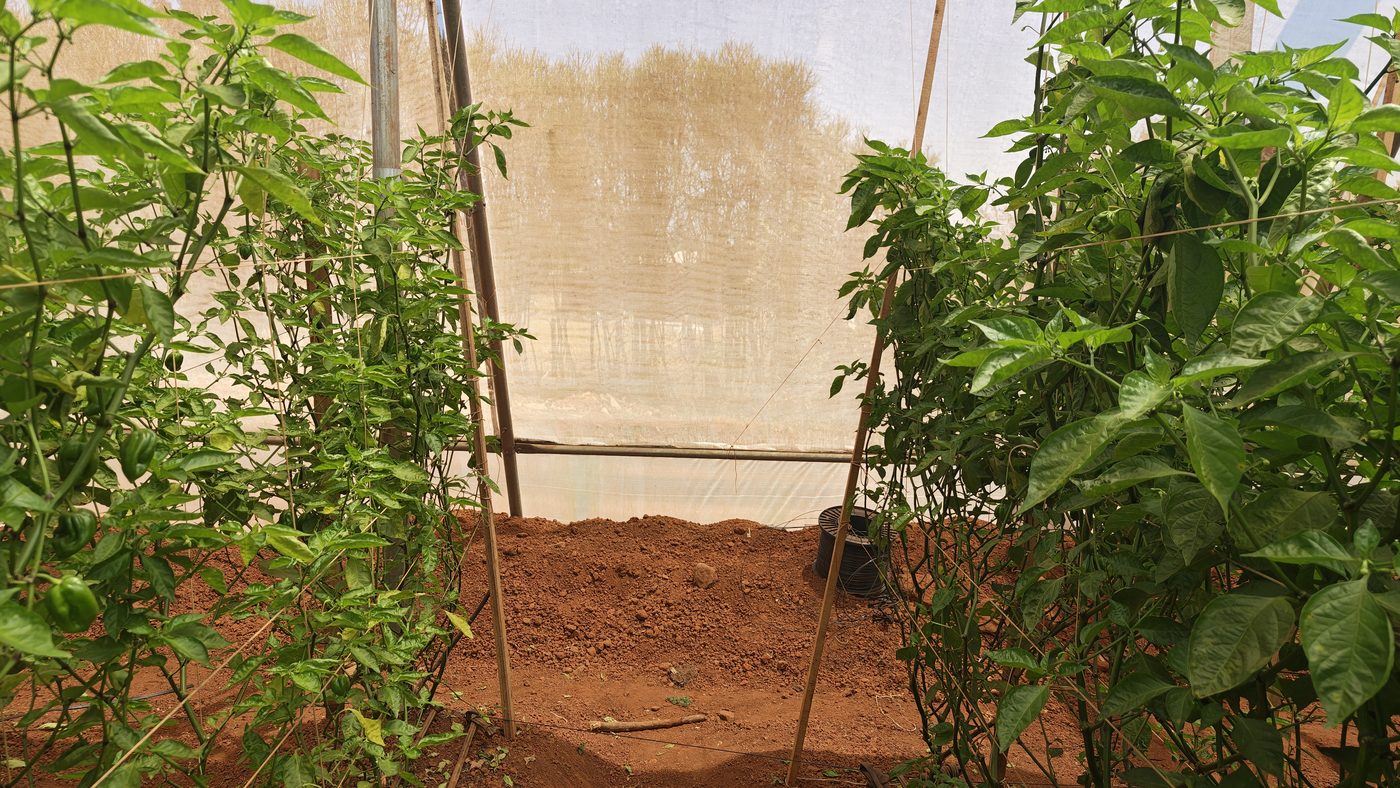
Drip lines under chilli in Bugesera. Whatever the market is worth, this row is worth what the season brings.
The AI-in-agriculture market is going to grow. The four firms that show their working agree on the rate, and the demand underneath it was settled by the FAO before any of them existed. What the headline can't tell you is whether any of that growth reaches a Rwandan hillside, because the forecasts weren't built to ask. That isn't a market question. It's a design decision, made one product at a time, by whoever decides to build for the phone the farmer already has. We wrote up the ten shifts that actually are landing here in our September piece on Rwandan agritech. Most of them wouldn't show up in any of the five reports above.